A field guide · First edition 2026

The move-in date is set. The house is still full.

A six-week field guide for adult children emptying a parent's home before assisted living — what to find before you throw anything away, what things are actually worth, and how to have the five conversations nobody prepares you for.

Instant PDF download·78 pages·Free 7-page sample below

The cover of Six Weeks to Move Day, a field guide 78 pages
~40% of gross is what estate sale companies typically take in commission and fees SmartAsset
$40–$150 per hour for a senior move manager, or $1,500–$5,000 per project A Place for Mom
42% of estate sales gross under $10,000 — before that commission SmartAsset
49 sources cited in the guide, each with a live URL you can check yourself

Where you are

You got the call, or you made it. There is a date now. Somewhere between four and eight weeks out, a room is waiting.

And there is a house. Fifty years of a house. A garage you have not fully seen since you were seventeen. A basement with boxes nobody has opened since the last move. Closets full of clothes that fit a person who was a different size and a different age.

You have a job. You may have children. You may have siblings who are helpful, or siblings who are not, or siblings who are helpful in ways that create more work.

And underneath all of it, the part nobody says out loud: your parent is losing their home, and you are the one taking it apart.

Most people start in the wrong place. They start with the biggest, most emotional room, on the first free Saturday, with no plan and no boxes. Two hours later they are sitting on the floor reading letters, and nothing has moved.

The order matters more than the speed.

There are things in that house that cannot be replaced and cannot be recovered once they leave in a bag — discharge papers, savings bonds, deeds, policies, keys to boxes at banks nobody remembers opening. There is a sequence that protects those. Almost nobody knows it, because almost nobody does this more than twice in a lifetime.

There are also things you believe are valuable that are not, and things you would discard that are. Families routinely expect a dining set to carry the cost of the move. The market has moved. Knowing this in week one changes how you spend every hour after it.

This guide is that sequence.
What's inside

Seven parts, five appendices, one order of operations.

Written to be used in pieces, not read cover to cover. Read Part One tonight and the rest week by week.

One

Before You Touch Anything

The Document Sweep: what has to be found before the first bag goes out, and the specific places these things hide in older people's homes. Unclaimed property and savings bonds, step by step. The list of commonly discarded items that turn out to matter.

Two

The Conversations

Why objects hold so much weight for someone at the end of a long life — grounded in the actual research, not sentiment. Then the five conversations, each with an opening line, what to do when it goes badly, and what not to say. Including the one with your siblings about who is actually doing the work.

Three

The Six-Week Countdown

A week-by-week plan working backward from move day. What has to happen before what, and the one thing people get wrong each week.

Four

Room by Room

Kitchen through attic, with the traps in each. Full hazard routing: old paint, chemicals, mercury thermostats, medications, firearms — where each one legally and safely goes.

Five

Where It All Goes

The honest value conversation, with real numbers. How estate sales actually work economically. What each major charity will and will not take, including where they contradict each other. Real price ranges for junk removal and dumpsters. What to do with photos and letters at volume.

Six

The New Place

What actually fits, in real square footage. Specific quantities for what to bring. What facilities commonly prohibit and send home.

Seven

Move Day and After

The move day sequence. The first two weeks. And an honest account of what you may feel when it is over, which is rarely relief.

A–E

Appendices

The Document Sweep checklist. The six-week master checklist. Questions to ask an estate sale company. Questions to ask a senior move manager. A budget worksheet with real cost ranges.

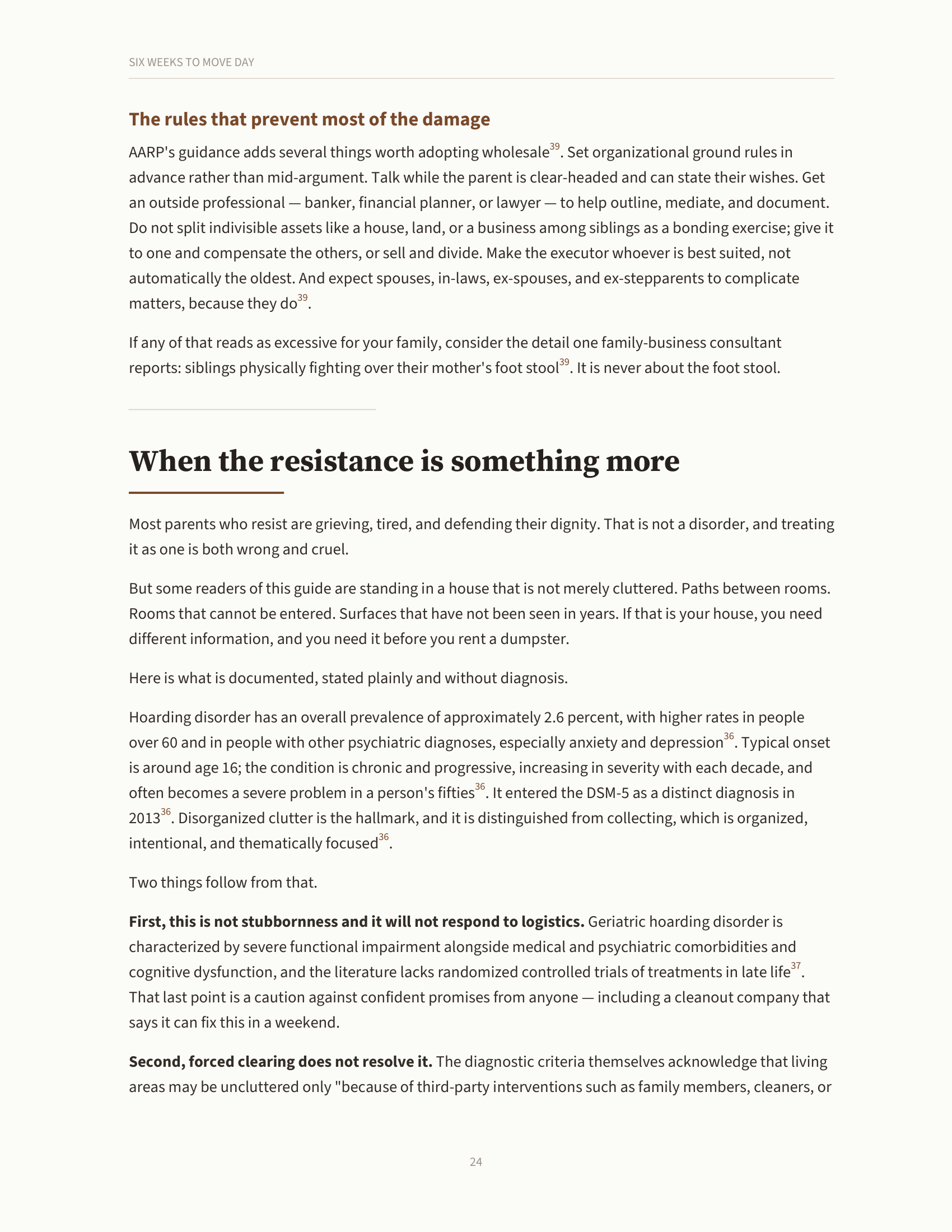
A page from the six-week countdown showing week-by-week tasks
Part Three — the week-by-week countdown, with the one thing people get wrong each week.
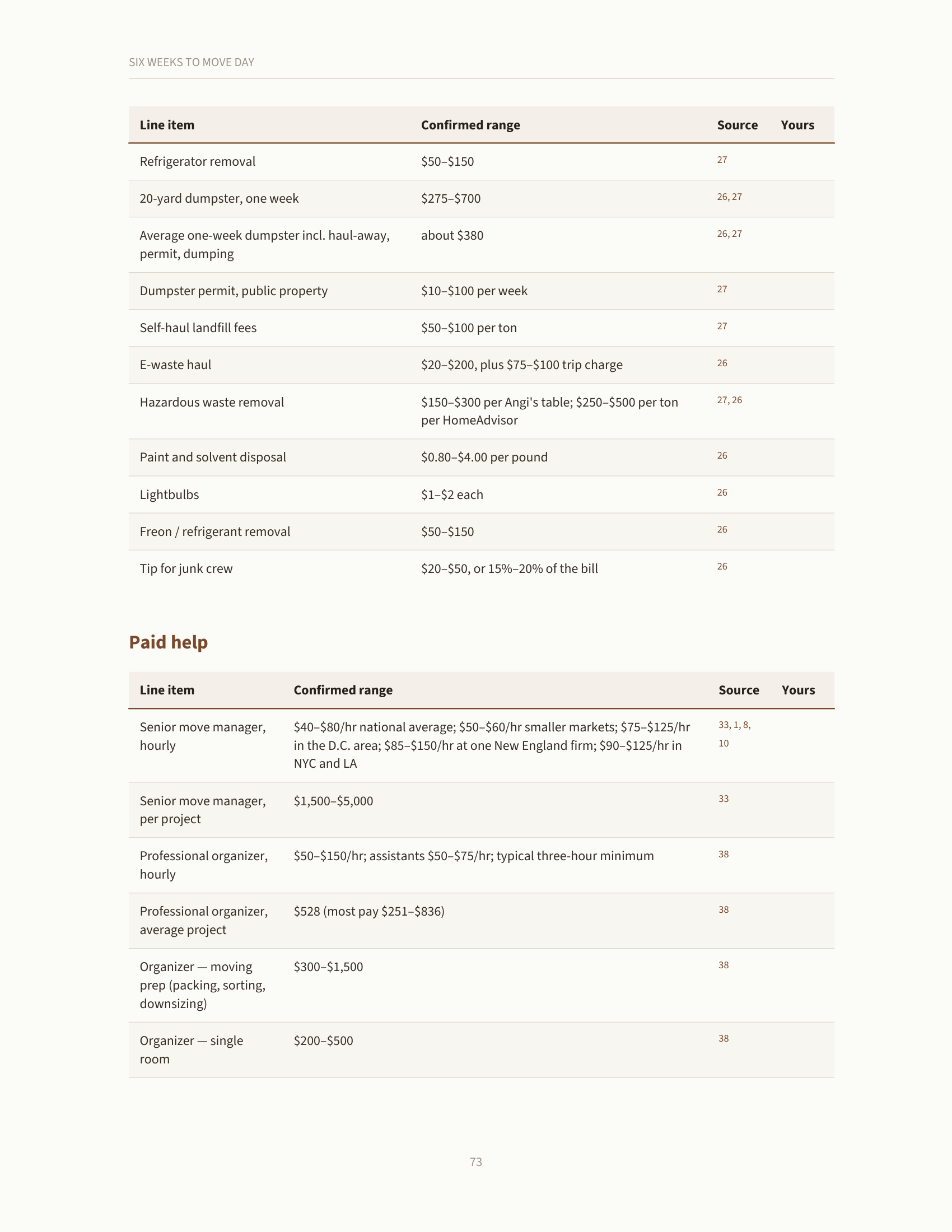
A page from the budget worksheet showing cited cost ranges
Appendix E — the budget worksheet. Every figure carries the source it came from.

Why not just search

Free articles are written to be found, not to be used.

They are lists of tips in no particular order, and the order is the entire problem.

This guide is sequenced, sourced, and specific. Every price and rule in it is cited to a real source with a live URL — the IRS, the EPA, the ATF, the National Archives, published academic research on object attachment in later life. You can check every one of them.

Why not just hire someone

Sometimes you should — and the guide tells you when.

Senior move managers charge roughly $40 to $150 an hour, or $1,500 to $5,000 for a project. Estate sale companies typically take around 40% of gross. Those are often worth it, and the guide includes the questions to ask before you sign with either.

But most of the work is decisions, and nobody can make those for you. This guide makes the decisions faster and stops you making the expensive ones twice.

This is for you if

  • You have a real move-in date, roughly four to eight weeks out
  • You are the one doing most of the work
  • You want a plan, not encouragement

This is not for you if

  • You are looking for legal, financial, or tax advice. This guide is none of those, and says so on page one. It tells you which questions to ask and which professional to ask them of.
  • You have six months. You have time to do this gently, and should.
  • You want someone to do it for you. Hire a senior move manager — the guide has the questions to ask them.

Free, no email required

The Document Sweep checklist

The single most time-critical part of the guide: everything that has to be found before the first bag leaves the house, and the specific places these things hide in older people's homes. Print it and start tonight.

Download the checklist (PDF)

7 pages, including the full table of contents. No signup, no email capture, no follow-up sequence. Read it before you decide whether to buy the rest.

The guide

One file. Everything above.

78 pages, delivered as a PDF the moment you pay. Readable on a phone in a hospital corridor and printable on a kitchen table, which is where most of it will actually be used.

Read part of it before you decide.

This is a digital file that reaches you the second you pay, so all sales are final. That is exactly why the sample below is not a teaser — it is a real appendix and the full table of contents, seven pages, free, no email required. Read that first, and buy the rest only if it is the kind of thing you need.

$39 one time

Instant download. Yours permanently.

  • 78-page PDF, seven parts
  • Five printable appendices and checklists
  • 49 cited sources with live URLs
  • Free updates to the first edition
  • Emailed to you instantly, link good 30 days
  • Digital download — all sales final
Get the guide — $39

Secure checkout by Stripe · Card and Apple Pay

Questions

Before you buy

How long is it?

78 pages. Written to be used in pieces, not read cover to cover. Read the first section tonight and the rest week by week.

Is this legal or financial advice?

No, and it is careful about that. Wills, estates, taxes, and property are named clearly as questions for an attorney or a tax professional. What this guide gives you is the list of questions and the order to ask them in.

My parent is in a different state.

Most of the guide still applies. Costs and disposal rules vary by state, and the guide tells you which items are state-dependent and where to look them up.

We have more than six weeks.

Use the same order, more slowly. The sequence is the value; the calendar is a container.

What format is it, and how is it delivered?

A PDF, readable on anything. The download appears immediately after payment, and a private link is emailed to you as well so you can get the file back on any device for the next thirty days.

Can I get a refund?

No. The guide arrives in full the moment you pay, so all sales are final. That is why there is a free seven-page sample with no email gate — read the Document Sweep checklist and the full table of contents, and buy only if it is what you need.

You are going to do this either way.

The only question is whether you do it in the right order.

Get the guide — $39